
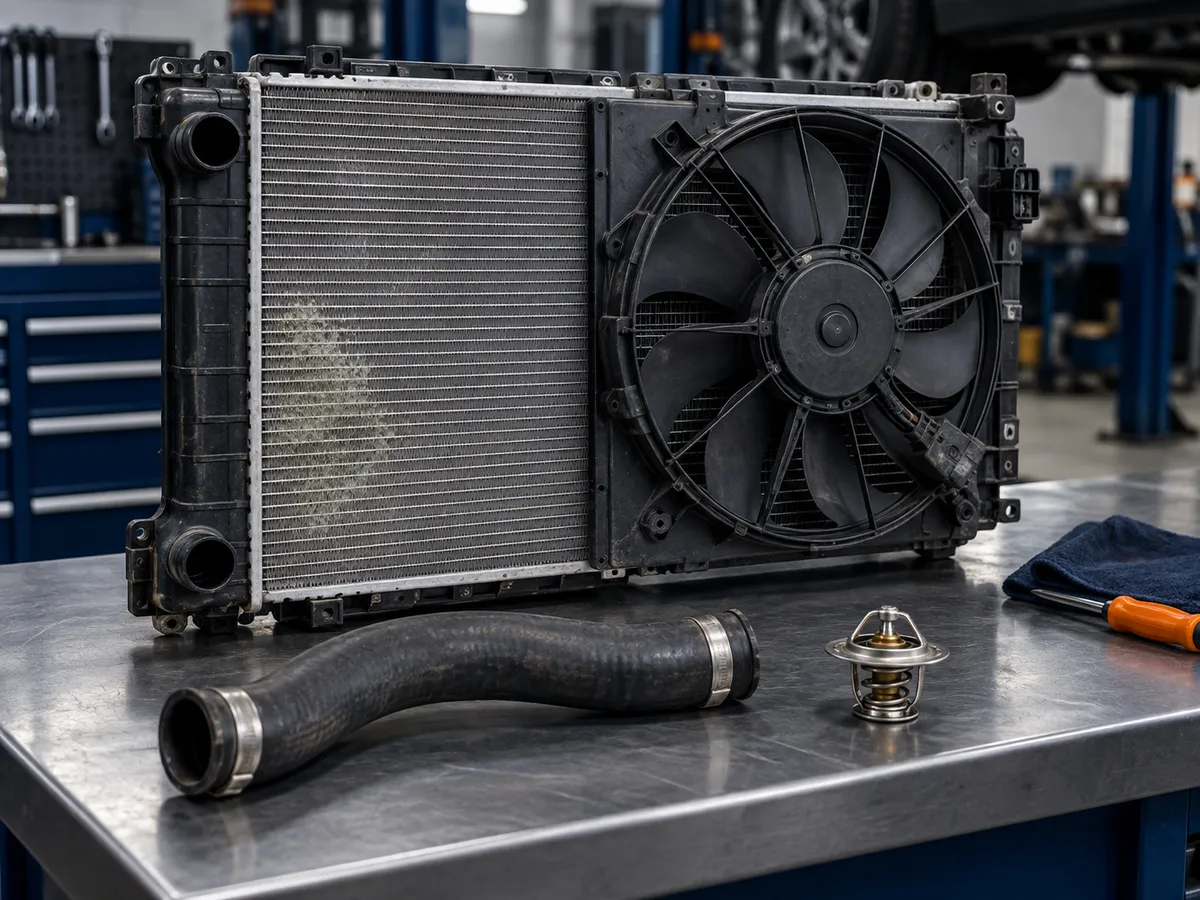
Coolant leak
Green, pink or blue fluid under the front of the car, or a reservoir that keeps dropping, means coolant is escaping. Usual sources are hoses, the radiator or the water pump. A small leak can become a sudden overheat in summer, so fix it before it gets worse.
Get it checked soon
Likely causes
| Likely cause | How likely | The fix |
|---|---|---|
Cracked or loose hoses Rubber hoses harden in heat and crack at the clamps. Pressure testing shows the leak. | Common | Radiator hose replacement |
Radiator leak Plastic tanks crack and cores corrode, especially when plain water was used. A pressure test confirms it. | Common | Radiator repair |
Water pump seal A worn pump weeps from its weep hole. Residue under the pump confirms it. | Possible | Water pump replacement |
Water pump behind the timing beltSome cars only On many belt engines the pump is driven by the timing belt, and a leaking pump can soak the belt and shorten its life. Both are usually replaced together. | Possible | Timing belt replacement |
Hybrid inverter coolant loop leakSome cars only Hybrids have a separate coolant reservoir for the inverter. A leak there shows as a low level in the second reservoir and can trigger hybrid warnings. | Possible | Inverter cooling inspection |
Corroded heater core on an older carSome cars only Older heater cores corrode inside and leak into the cabin, leaving a damp footwell and misty windscreen. | Possible | Heater repair |
Turbo coolant line leakSome cars only Water-cooled turbos have small coolant pipes near the exhaust whose seals fail with heat. Residue near the turbo confirms it. | Less common | Coolant leak repair |
General guidance based on how these cars are built and how they commonly wear. Your car’s own history matters more than any list, which is why a technician confirms the cause before quoting.
Can you keep driving?
Short trips are fine if the level is kept topped up and the temperature gauge stays normal. If the gauge rises or the reservoir empties quickly, stop driving.
Checks you can do first
- Check the coolant level when cold, every few days.
- Look for coloured drips or crusty residue on hoses and the radiator.
- Check for a sweet smell from the vents, which can mean a heater core leak.
- Never open a hot radiator cap.
How a technician diagnoses it
Step 1
Pressure-test the cooling system and cap.
Step 2
Use UV dye for slow or intermittent leaks.
Step 3
Check engine oil for coolant contamination.
Step 4
Inspect the hybrid inverter loop separately where fitted.
Cars where this is widely reported
- Toyota Premio leaking coolantThe 2ZR-FE engine in the T260 is known for water pump seepage, visible as dried coolant residue near the pump.
- Toyota Mark X leaking coolantWater pump leaks are a known issue on the GR-series V6 engines as they age.
- Toyota Crown leaking coolantWater pump leaks are commonly reported on the GR-series V6 petrol engines as they age.
By car model
- Toyota Prius leaking coolant
- Toyota Camry leaking coolant
- Toyota Hilux leaking coolant
- Toyota Fortuner leaking coolant
- Toyota Land Cruiser Prado leaking coolant
- Toyota Land Cruiser leaking coolant
- Honda Civic leaking coolant
- Honda Fit leaking coolant
- Suzuki Mehran leaking coolant
- Suzuki Bolan leaking coolant
- Suzuki Ravi leaking coolant
- Suzuki Khyber leaking coolant
- Suzuki Margalla leaking coolant
- Suzuki Baleno leaking coolant
- Daihatsu Cuore leaking coolant
- Nissan Note leaking coolant
- Hyundai Santa Fe leaking coolant
- Hyundai Santro leaking coolant
- MG HS leaking coolant
- Haval H6 leaking coolant
- Haval Jolion leaking coolant
- Mitsubishi Lancer leaking coolant
- Mitsubishi Pajero leaking coolant
- Toyota Probox leaking coolant
- Toyota Noah leaking coolant
- Toyota Voxy leaking coolant
- Toyota Hiace leaking coolant
- Toyota Corolla Axio leaking coolant
- Suzuki APV leaking coolant
Warning lights and codes linked to it
Parts usually involved

Have it diagnosed
Tell us the car, the symptom and your city. A person calls back to say what we can do there and what the diagnosis costs.
Before you book
Questions we get asked

If your question is not here, ask it. We would rather answer honestly now than have you find out after booking.