
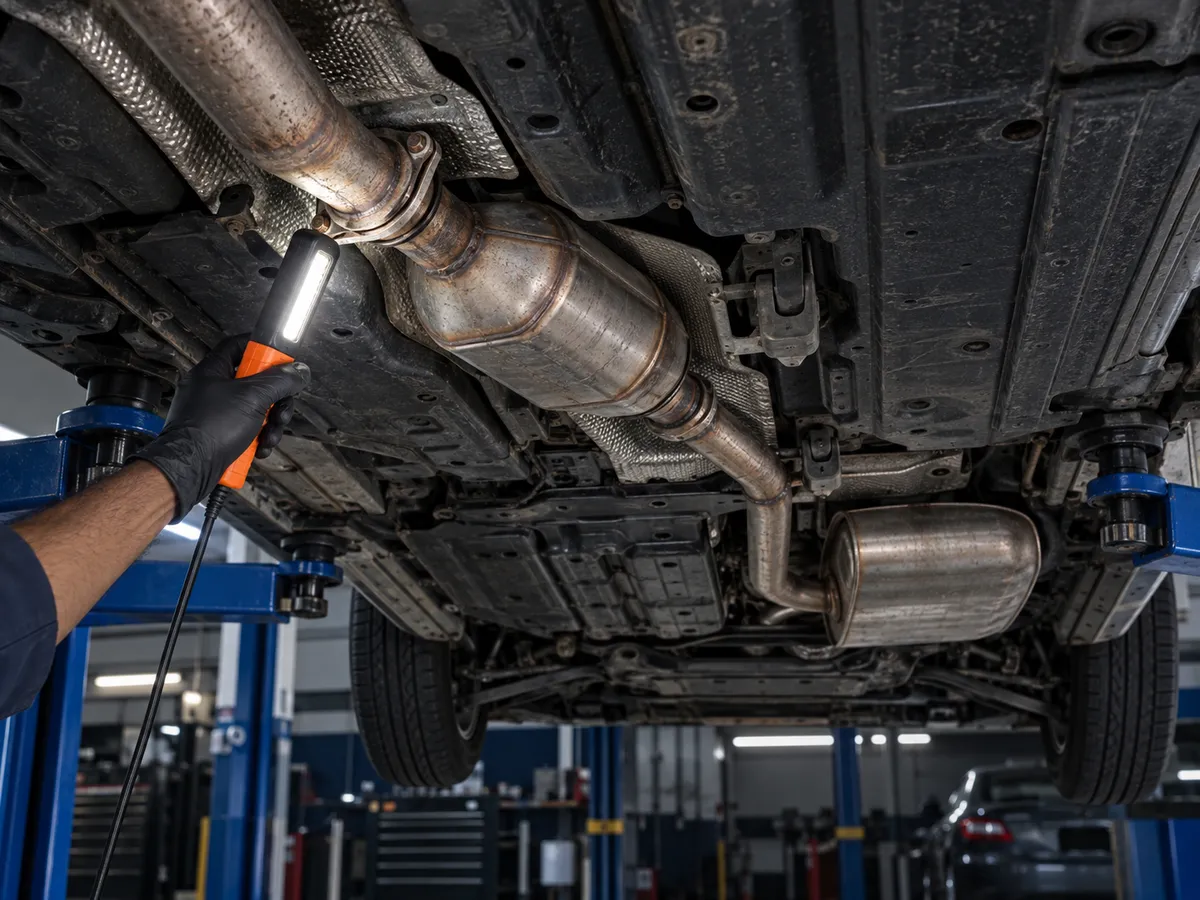
Loud exhaust noise
A sudden roar, rattle or ticking from the exhaust usually means a hole, broken joint, failed silencer or a leaking manifold gasket. Apart from the noise, a leak can let fumes into the cabin. It should be repaired soon.
Get it checked soon
Likely causes
| Likely cause | How likely | The fix |
|---|---|---|
Rusted silencer or pipe Moisture and short trips rot exhaust parts from inside. Inspection finds holes. | Common | Silencer replacement |
Broken hanger or joint Speed breakers and rough roads break hangers. Inspection shows loose sections. | Common | Exhaust repair |
Manifold gasket or cracked manifold A ticking noise when cold points to a manifold leak. Inspection and soot marks confirm it. | Possible | Exhaust manifold repair |
Rattling catalytic converter A broken catalyst core rattles. Tapping the converter confirms it. | Possible | Catalytic converter diagnosis |
Turbo or downpipe leakSome cars only Turbo engines lose boost through downpipe or turbo flange leaks with a hissing noise. Inspection under load confirms it. | Possible | Exhaust leak repair |
Damage on low-slung small carsSome cars only Small hatchbacks and kei cars scrape exhausts on speed breakers. Inspection shows dents and cracks. | Possible | Exhaust repair |
Diesel exhaust leak with sootSome cars only Diesel exhausts leak soot at joints. Black marks show the leak point. | Possible | Exhaust leak repair |
General guidance based on how these cars are built and how they commonly wear. Your car’s own history matters more than any list, which is why a technician confirms the cause before quoting.
Can you keep driving?
Usually yes for short trips, but if you smell exhaust inside the car, keep windows open and get it fixed quickly. If a part is hanging, stop.
Checks you can do first
- Look under the car for a hanging pipe or broken hanger.
- Note whether the noise is at the front (engine bay) or the rear.
- Check for exhaust smell in the cabin.
How a technician diagnoses it
Step 1
Lift and inspect the whole exhaust for holes and broken hangers.
Step 2
Check manifold and joints for soot marks.
Step 3
Tap the converter for internal rattle.
Step 4
Check for cabin fume entry.
By car model
- Toyota Corolla with a loud exhaust
- Toyota Hilux with a loud exhaust
- Toyota Fortuner with a loud exhaust
- Toyota Land Cruiser Prado with a loud exhaust
- Toyota Land Cruiser with a loud exhaust
- Honda Civic with a loud exhaust
- Nissan Sunny with a loud exhaust
- Kia Carnival with a loud exhaust
- Mitsubishi Pajero with a loud exhaust
- Toyota Hiace with a loud exhaust
- Honda N-Box with a loud exhaust
- Suzuki Hustler with a loud exhaust
Parts usually involved

Have it diagnosed
Tell us the car, the symptom and your city. A person calls back to say what we can do there and what the diagnosis costs.
Before you book
Questions we get asked

If your question is not here, ask it. We would rather answer honestly now than have you find out after booking.