
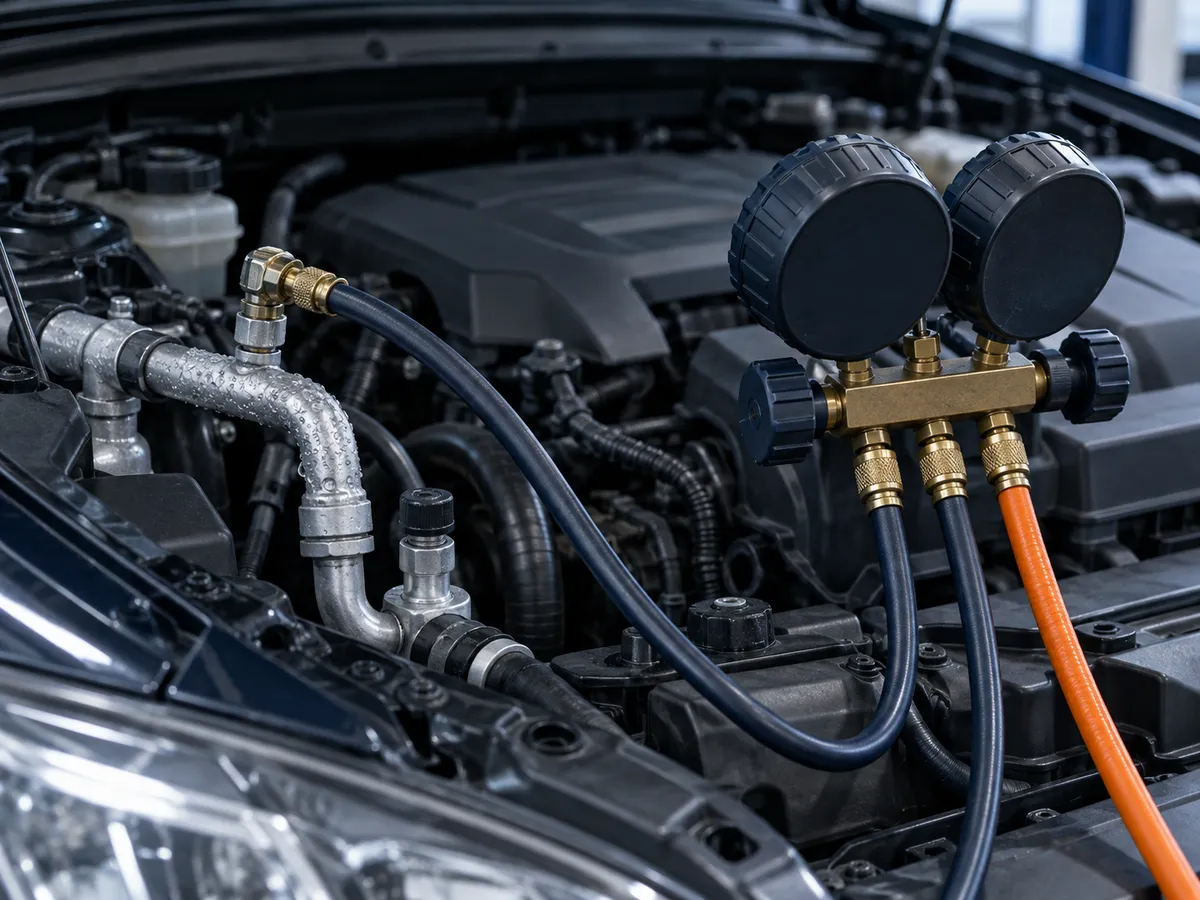
AC not cooling
Weak or warm AC is most often low refrigerant from a slow leak, a clogged condenser or a failing compressor clutch. It is not a safety issue but it matters in a Pakistani summer. A proper diagnosis with pressure gauges is better than topping up gas repeatedly.
Keep an eye on it
Likely causes
| Likely cause | How likely | The fix |
|---|---|---|
Low refrigerant from a leak Refrigerant does not get used up; if it is low, there is a leak. Pressure readings and a dye or electronic leak test find it. | Common | Ac leak detection |
Blocked or damaged condenser Dust and debris on the condenser stop it shedding heat, so high-side pressure climbs and cooling drops. High pressure readings and a dirty core confirm it. | Common | Condenser replacement |
Compressor or clutch failure A worn clutch or internal wear stops the compressor building pressure. Low high-side and high low-side pressures together point to it. | Possible | Ac compressor repair |
Weak radiator fan The fan also cools the condenser, so a weak fan gives warm air at idle and better cooling on the move. Fan speed and current checks confirm it. | Possible | Cooling fan repair |
Electric compressor or inverter fault on a hybridSome cars only Many hybrids drive the compressor electrically from the high-voltage system, so faults show as hybrid codes rather than a slipping belt. It needs a hybrid-capable scanner and correct insulating compressor oil. | Possible | Hybrid electrical diagnosis |
Compressor cut-off on a small engine under loadSome cars only Small engines cut the compressor at full throttle and on climbs to protect performance, so the AC feels weak on hills. Checking the cut-off signal in live data confirms normal behaviour versus a fault. | Possible | Ac diagnosis |
Worn drive belt slipping on the compressorSome cars only On older cars a glazed or loose belt slips under compressor load and squeals. Belt condition and tension are checked. | Possible | Drive belt replacement |
General guidance based on how these cars are built and how they commonly wear. Your car’s own history matters more than any list, which is why a technician confirms the cause before quoting.
Can you keep driving?
Yes, it is safe to drive. If the compressor is making a grinding noise, switch the AC off until it is checked to avoid seizing it and damaging the drive belt.
Checks you can do first
- With the engine running and AC on, see whether the compressor clutch at the front of the engine engages.
- Check the condenser in front of the radiator for dust, leaves and bent fins.
- Check the cabin filter; a blocked one reduces airflow at the vents.
- Note whether it cools while driving but not at idle, which points to airflow or the fan.
How a technician diagnoses it
Step 1
Connect gauges and read high- and low-side pressures at idle and at 1,500 rpm.
Step 2
Measure vent temperature against ambient temperature.
Step 3
Leak-test with dye or an electronic detector before any recharge.
Step 4
Check compressor clutch, fan operation and pressure switch signals.
Cars where this is widely reported
- Toyota Corolla AC not coolingIn peak summer the condenser, sitting behind the grille, collects dust and insects, and weak cooling in traffic is often traced to a blocked condenser or a tired compressor clutch.
- Toyota Yaris AC not coolingCooling in peak summer traffic depends heavily on a clean condenser and correct gas charge, so weak cooling is often a service issue rather than a failed part.
- Toyota Vitz AC not coolingThe small engine and compressor struggle in summer traffic, and any loss of gas or a dirty condenser shows up quickly as weak cooling.
- Toyota Passo AC not coolingThe small AC system is quickly overwhelmed in summer when the condenser is dirty or the gas is low.
- Toyota Premio AC not coolingAs cars age, weak AC in summer is often the condenser or a leaking line rather than the compressor.
- Toyota Corolla Cross AC not coolingThe AC compressor is electrically driven on this hybrid, so AC faults need a technician familiar with hybrid systems.
- Toyota Camry AC not coolingLong idling with the AC on, common for chauffeured cars, wears the compressor and fan faster.
- Toyota Land Cruiser AC not coolingThe front and rear AC systems mean longer lines and more joints, so slow gas leaks are common on older cars.
- Honda Civic AC not coolingWeak cooling in summer traffic on older Civics is often a worn compressor clutch or a dirty condenser.
- Honda City AC not coolingWeak summer cooling on older Cities often traces to a dirty condenser or a slow gas leak.
- Honda BR-V AC not coolingOwners often find that cooling for third-row passengers is weak in peak summer.
- Honda N-WGN AC not coolingThe small AC system struggles in summer traffic when the condenser is dirty or gas is low.
- Honda HR-V AC not coolingWeak cooling in summer is most often a dirty cabin filter or condenser on a car this new.
- Honda Accord AC not coolingOlder Accords commonly develop AC compressor clutch wear, giving weak cooling in heat.
- Suzuki Alto AC not coolingWith a small engine the AC compressor takes a large share of power, so a dirty condenser behind the grille shows up quickly as weak cooling in summer.
- Suzuki Wagon R AC not coolingWeak cooling on hot days is a common complaint, often helped by cleaning the condenser and checking the refrigerant charge.
- Suzuki Swift AC not coolingOwners often report the AC struggling in peak summer, usually traced to a dirty condenser or low refrigerant.
- Suzuki Liana AC not coolingAgeing AC systems on Lianas often need condenser cleaning and a refrigerant check before summer.
- Suzuki Vitara AC not coolingAs on most cars in Pakistani summers, a dusty condenser commonly reduces cooling.
- Daihatsu Mira AC not coolingThe small compressor struggles in peak heat, and a dirty condenser makes cooling noticeably weaker.
- Nissan Dayz AC not coolingThe small engine and compressor can struggle in extreme heat, especially with a dusty condenser.
- Hyundai Tucson AC not coolingWeak cooling in peak summer traffic is a common Tucson complaint and is usually traced to a clogged condenser, low gas or a dirty cabin filter.
- Hyundai Elantra AC not coolingReduced AC performance in heavy summer traffic usually comes down to condenser cleaning, gas level or the cabin filter.
- Hyundai Sonata AC not coolingIn peak heat, weak cooling is usually a dirty condenser or a cabin filter that has not been changed.
- Kia Sportage AC not coolingWeak AC in summer traffic is commonly a dirty condenser, low gas or a clogged cabin filter.
- Kia Picanto AC not coolingThe small engine shares power with the AC, so a dirty condenser or low gas shows up quickly as weak cooling.
- Kia Stonic AC not coolingWeak AC on hot days is usually a dirty condenser, low gas or a clogged cabin filter.
- Kia Sorento AC not coolingCooling a large three-row cabin is hard in peak heat, and a dirty condenser or low gas makes it obvious.
- Kia Carnival AC not coolingCooling three rows of seats in summer exposes any weakness in gas level or condenser cleanliness.
- Changan Alsvin AC not coolingWeak cooling in summer traffic is usually a dirty condenser, low gas or a clogged cabin filter.
- Changan Oshan X7 AC not coolingCooling three rows in summer traffic exposes a dirty condenser or low gas quickly.
- Changan Karvaan AC not coolingThe single AC unit struggles to cool the whole van in peak heat, more so with a dirty condenser or low gas.
- MG ZS AC not coolingWeak cooling in summer traffic is commonly a dirty condenser, low gas or blocked cabin filter.
- Proton Saga AC not coolingThe AC can feel weak in peak summer traffic, commonly due to a dirty condenser or low gas.
- Proton X70 AC not coolingWeak cooling in peak heat usually comes from a dirty condenser or low gas.
- Haval Jolion AC not coolingWeak cooling in peak heat is usually a dirty condenser, low gas or clogged cabin filter.
- FAW V2 AC not coolingWeak cooling in summer is commonly a dirty condenser or low gas.
- Prince Pearl AC not coolingThe small engine and AC struggle together in peak heat, and a dirty condenser or low gas makes cooling weak.
- United Bravo AC not coolingCooling is modest in peak heat, and a dirty condenser or low gas quickly makes it weak.
- Toyota Probox AC not coolingA dust-choked condenser and a weak compressor clutch are frequent reasons for poor cooling on hard-working Proboxes in summer traffic.
- Toyota Noah AC not coolingWith front and rear AC units, a slow refrigerant leak is a common reason the rear of the cabin stops cooling first.
- Toyota Voxy AC not coolingWeak cooling at the back of the cabin often points to a leak in the long pipe run to the rear evaporator.
- Toyota Corolla Axio AC not coolingWeak cooling in summer traffic is commonly a clogged condenser or a low refrigerant charge.
- Toyota Rush AC not coolingWeak cooling with a full cabin in summer is often down to a dusty condenser or a low refrigerant charge.
- Suzuki Kizashi AC not coolingWeak AC in summer is commonly a dusty condenser or a slow refrigerant leak on these older cars.
- Mazda Carol AC not coolingThe small engine and compressor struggle in peak summer, and a dusty condenser makes it worse.
- Mitsubishi eK Wagon AC not coolingWeak cooling in summer traffic is often a dusty condenser or low refrigerant.
By car model
- Toyota Aqua AC not cooling
- Toyota Prius AC not cooling
- Honda Fit AC not cooling
- Suzuki Mehran AC not cooling
- Suzuki Cultus AC not cooling
- Suzuki Khyber AC not cooling
- Daihatsu Cuore AC not cooling
- Nissan Moco AC not cooling
- Nissan Note AC not cooling
- Hyundai Santro AC not cooling
- Toyota Crown AC not cooling
- Honda Insight AC not cooling
- Daihatsu Boon AC not cooling
Parts usually involved
Have it diagnosed
Tell us the car, the symptom and your city. A person calls back to say what we can do there and what the diagnosis costs.
Before you book
Questions we get asked

If your question is not here, ask it. We would rather answer honestly now than have you find out after booking.