
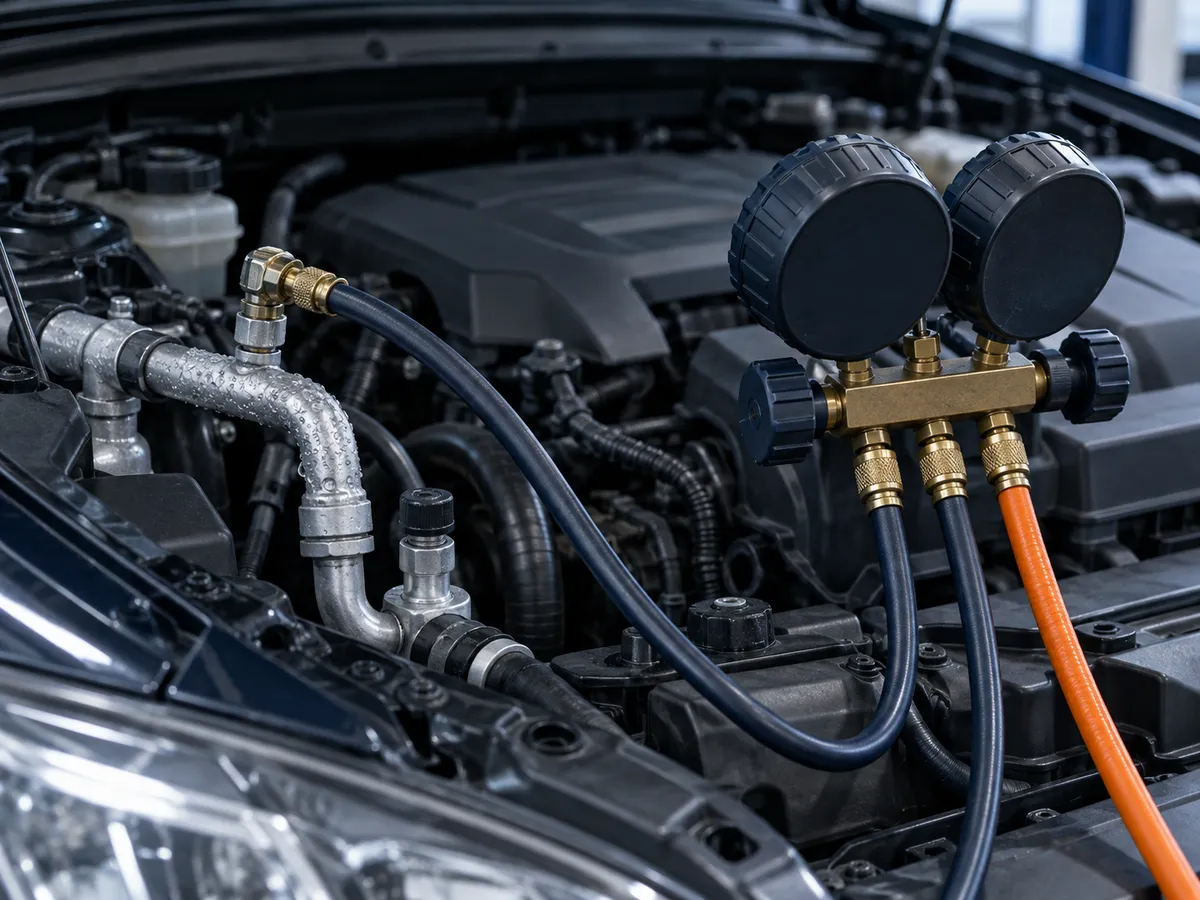
Toyota Camry AC not cooling
Long idling with the AC on, common for chauffeured cars, wears the compressor and fan faster. Below are the causes that fit a Toyota Camry, most likely first, and what fixes each one.
Why a Toyota Camry is AC not cooling
2.4 L 2AZ-FE petrol · 2.5 L 2AR-FE petrol · 2.5 L hybrid
| Likely cause | How likely | The fix |
|---|---|---|
Electric compressor or inverter fault on a hybridFits the Camry Many hybrids drive the compressor electrically from the high-voltage system, so faults show as hybrid codes rather than a slipping belt. It needs a hybrid-capable scanner and correct insulating compressor oil. | Possible | Hybrid electrical diagnosis |
Worn drive belt slipping on the compressorFits the Camry On older cars a glazed or loose belt slips under compressor load and squeals. Belt condition and tension are checked. | Possible | Drive belt replacement |
Low refrigerant from a leak Refrigerant does not get used up; if it is low, there is a leak. Pressure readings and a dye or electronic leak test find it. | Common | Ac leak detection |
Blocked or damaged condenser Dust and debris on the condenser stop it shedding heat, so high-side pressure climbs and cooling drops. High pressure readings and a dirty core confirm it. | Common | Condenser replacement |
Compressor or clutch failure A worn clutch or internal wear stops the compressor building pressure. Low high-side and high low-side pressures together point to it. | Possible | Ac compressor repair |
Weak radiator fan The fan also cools the condenser, so a weak fan gives warm air at idle and better cooling on the move. Fan speed and current checks confirm it. | Possible | Cooling fan repair |
Causes marked “Fits the Camry” apply because of how this car is built: its petrol/hybrid engine, AUTOMATIC gearbox, timing chain.
General guidance based on how these cars are built and how they commonly wear. Your car’s own history matters more than any list, which is why a technician confirms the cause before quoting.
Can you keep driving?
Yes, it is safe to drive. If the compressor is making a grinding noise, switch the AC off until it is checked to avoid seizing it and damaging the drive belt.
Checks you can do first
- With the engine running and AC on, see whether the compressor clutch at the front of the engine engages.
- Check the condenser in front of the radiator for dust, leaves and bent fins.
- Check the cabin filter; a blocked one reduces airflow at the vents.
- Note whether it cools while driving but not at idle, which points to airflow or the fan.
How a technician diagnoses it on a Camry
Step 1
Connect gauges and read high- and low-side pressures at idle and at 1,500 rpm.
Step 2
Measure vent temperature against ambient temperature.
Step 3
Leak-test with dye or an electronic detector before any recharge.
Step 4
Check compressor clutch, fan operation and pressure switch signals.
Other Toyota Camry problems
- Camry blowing blue smokeWidely reported on this model
- Camry leaking oilWidely reported on this model
- Camry with a weak hybrid batteryWidely reported on this model
- Camry not starting
- Camry showing a check engine light
- Camry squeaking when braking
- Camry having a soft brake pedal
- Camry vibrating through the steering wheel
- Camry knocking from the suspension
Parts usually involved

Get your Camry looked at
Tell us the Toyota Camry, the symptom and where the car is. A person calls back to say what we can do in your city and what the diagnosis costs.
Before you book
Questions we get asked

If your question is not here, ask it. We would rather answer honestly now than have you find out after booking.