
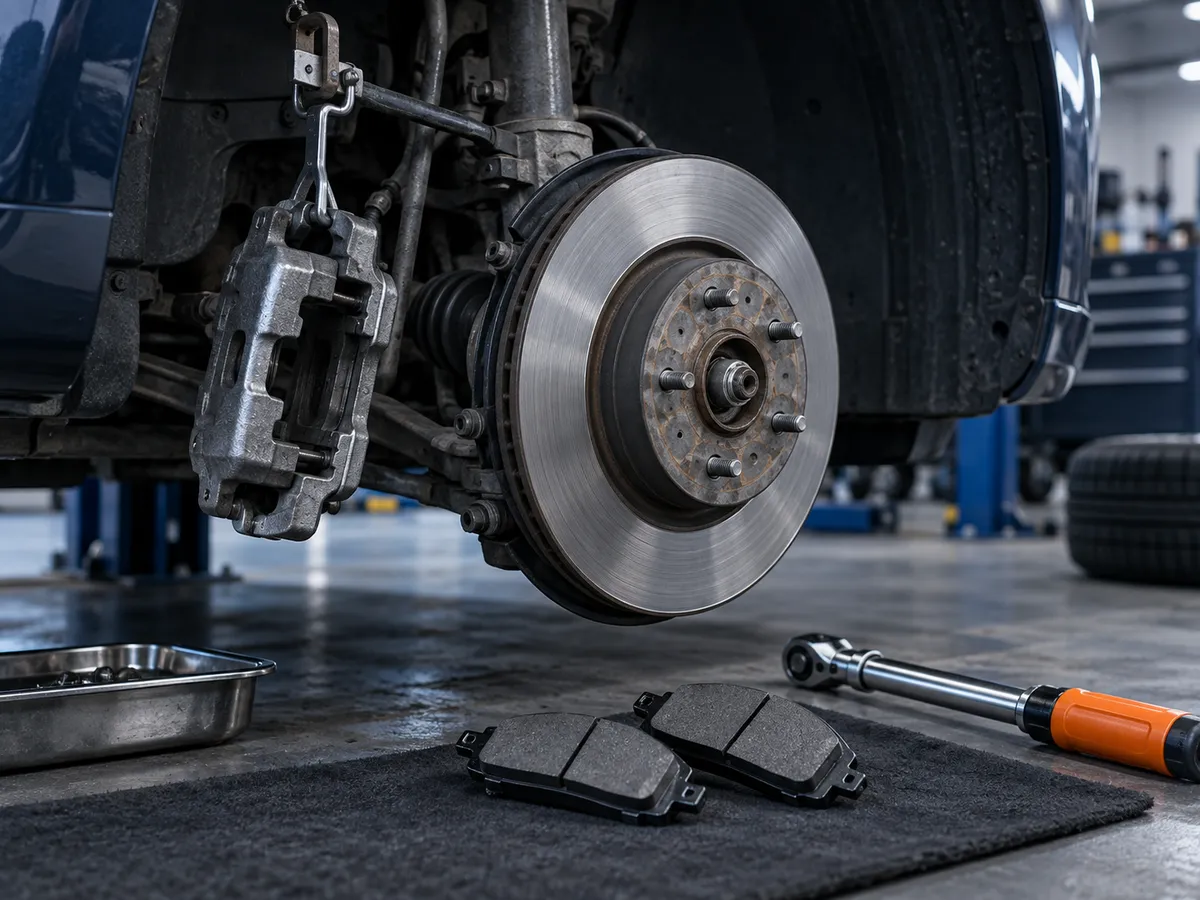
Grinding noise when braking
A harsh grinding when you brake usually means the pads or shoes have worn to metal and are cutting into the discs or drums. Stopping distances rise and discs get damaged quickly. Stop driving where possible and have the brakes inspected.
Stop driving
Likely causes
| Likely cause | How likely | The fix |
|---|---|---|
Pads worn to the backing plate Once the friction material is gone, steel scrapes the disc. Inspection shows no pad left. | Common | Brake pad replacement |
Rear brake shoes worn outSome cars only Drum brakes on many local cars wear their shoes until rivets touch the drum. Drum removal shows it. | Common | Brake drum service |
Stone or debris between pad and disc Gravel lodges by the backing plate, grinding constantly. Removing the wheel finds it. | Possible | Brake noise diagnosis |
Seized caliper A stuck caliper wears one pad unevenly to metal. Comparing pads side to side confirms it. | Possible | Brake caliper repair |
Rusted discs after standing or monsoon Surface rust grinds briefly after rain or parking; heavy pitting needs disc replacement. Inspection shows how deep it goes. | Possible | Brake disc replacement |
Worn wheel bearing A rough bearing can grind more under braking load. Wheel play and spin tests confirm it. | Less common | Wheel bearing replacement |
Heavy-vehicle brake wearSome cars only Pickups, vans and SUVs carrying loads wear brakes faster. Inspection shows rapid pad and shoe wear. | Possible | Brake pad replacement |
General guidance based on how these cars are built and how they commonly wear. Your car’s own history matters more than any list, which is why a technician confirms the cause before quoting.
Can you keep driving?
Only as far as a workshop, slowly and with extra distance. Metal-on-metal brakes can fail to stop the car in time.
Checks you can do first
- Look through the wheel spokes at pad thickness and disc surface.
- Note whether grinding is from the front or rear.
- Check for grooves or a raised lip on the disc edge.
- Note whether the noise happens only after rain or washing.
How a technician diagnoses it
Step 1
Remove wheels and measure pad, shoe and disc thickness.
Step 2
Check calipers for sticking and pads for uneven wear.
Step 3
Inspect drums and wheel bearings.
Step 4
Road test after repair to confirm quiet braking.
By car model
- Toyota Hilux grinding when braking
- Suzuki Bolan grinding when braking
- Suzuki Every grinding when braking
- Suzuki Ravi grinding when braking
- Daihatsu Hijet grinding when braking
- Nissan Clipper grinding when braking
- Hyundai Porter grinding when braking
- Changan Karvaan grinding when braking
- Toyota Probox grinding when braking
- Toyota Hiace grinding when braking
- Suzuki APV grinding when braking
Warning lights and codes linked to it
Parts usually involved
Have it diagnosed
Tell us the car, the symptom and your city. A person calls back to say what we can do there and what the diagnosis costs.
Before you book
Questions we get asked
If your question is not here, ask it. We would rather answer honestly now than have you find out after booking.