
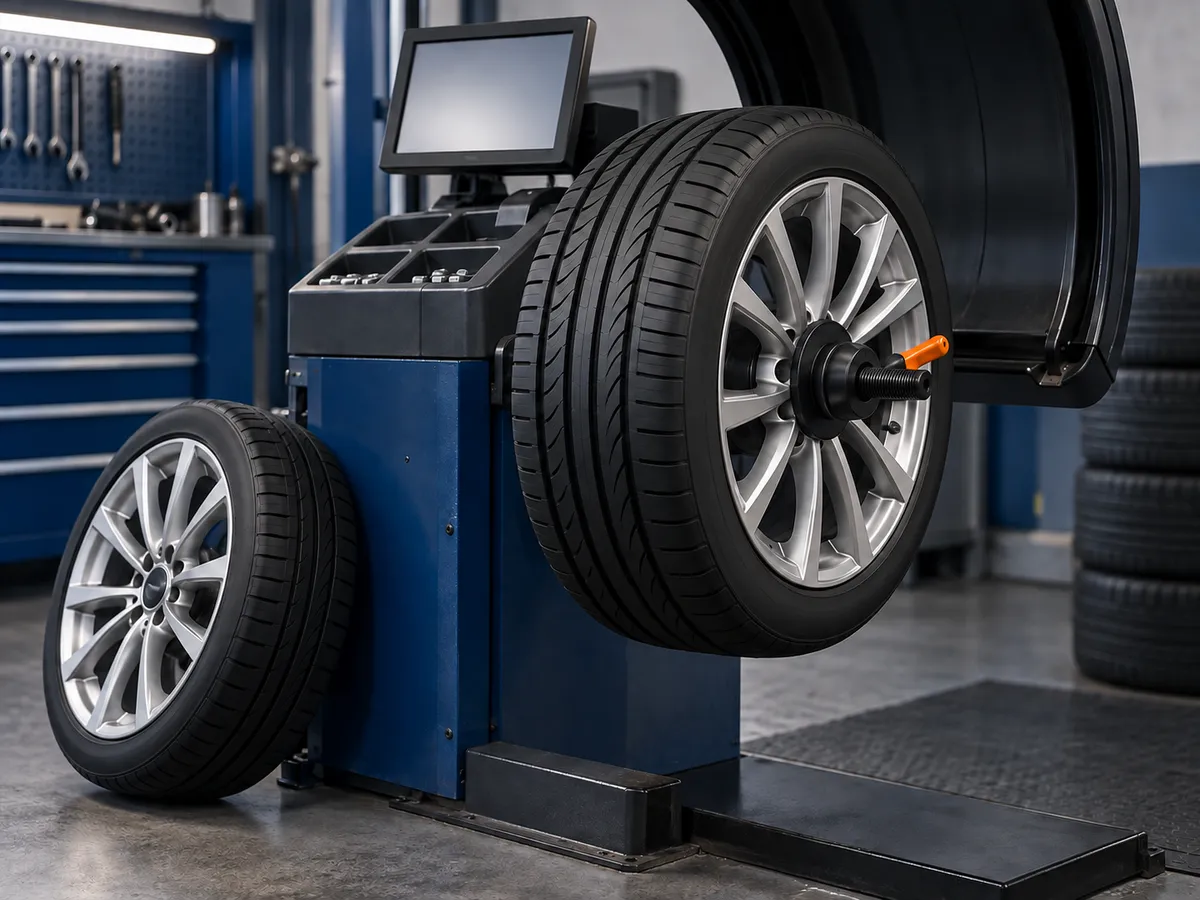
Steering wheel vibration
A steering wheel that shakes at certain speeds usually means a front wheel is out of balance or a rim is bent. If it shakes mainly when braking, the brake discs are likely uneven. It wears suspension parts and should be fixed soon.
Get it checked soon
Likely causes
| Likely cause | How likely | The fix |
|---|---|---|
Wheel out of balance A lost weight or uneven tyre wear causes shake usually between 80 and 110 km/h. Spin-balancing confirms it. | Common | Wheel balancing |
Bent rim from a pothole A rim bent by a pothole or speed breaker cannot be balanced out. It shows as runout on the balancing machine. | Common | Rim repair |
Warped or uneven brake discs Discs with uneven thickness pulse the pedal and shake the wheel under braking. Measuring runout and thickness variation confirms it. | Common | Brake disc replacement |
Worn tie-rod ends or ball jointsSome cars only Play in steering joints lets the wheel shimmy. A check for movement with the wheel off the ground finds it. | Possible | Tie rod replacement |
Worn inner CV jointSome cars only On front-wheel-drive cars, a worn inner CV joint causes vibration under acceleration that eases when coasting. Torn boots and grease spray are clues. | Possible | Cv joint replacement |
Worn front-axle parts on a 4x4Some cars only Four-wheel-drive vehicles have extra front drivetrain joints and hubs that cause shake when worn. Checking the front shafts and hubs on a lift finds them. | Possible | Differential repair |
Separated tyre belt Internal belt damage creates a bump in the tread that shakes at low speed too. It needs replacement, not balancing. | Less common | Tire replacement |
General guidance based on how these cars are built and how they commonly wear. Your car’s own history matters more than any list, which is why a technician confirms the cause before quoting.
Can you keep driving?
Generally yes at moderate speeds. If the vibration is severe, sudden, or came after hitting something, check the wheel nuts and tyre for a bulge before continuing.
Checks you can do first
- Note the speed range where it shakes and whether it is worse when braking.
- Look at each tyre sidewall for bulges or cuts.
- Check the inner rim edges for dents from potholes.
- Check that no wheel balance weights are missing (clean marks on the rim).
How a technician diagnoses it
Step 1
Balance all four wheels and check rim runout.
Step 2
Measure brake disc runout and thickness.
Step 3
Inspect steering joints and CV joints for play.
Step 4
Road-test to confirm the speed range is cured.
By car model
- Toyota Corolla vibrating through the steering wheel
- Toyota Vitz vibrating through the steering wheel
- Toyota Prius vibrating through the steering wheel
- Toyota Passo vibrating through the steering wheel
- Toyota Premio vibrating through the steering wheel
- Toyota Camry vibrating through the steering wheel
- Toyota Hilux vibrating through the steering wheel
- Toyota Fortuner vibrating through the steering wheel
- Toyota Land Cruiser Prado vibrating through the steering wheel
- Toyota Land Cruiser vibrating through the steering wheel
- Honda Civic vibrating through the steering wheel
- Honda City vibrating through the steering wheel
- Honda Vezel vibrating through the steering wheel
- Honda Fit vibrating through the steering wheel
- Honda Accord vibrating through the steering wheel
- Honda Grace vibrating through the steering wheel
- Suzuki Alto vibrating through the steering wheel
- Suzuki Cultus vibrating through the steering wheel
- Suzuki Every vibrating through the steering wheel
- Suzuki Khyber vibrating through the steering wheel
- Suzuki Margalla vibrating through the steering wheel
- Suzuki Liana vibrating through the steering wheel
- Suzuki Baleno vibrating through the steering wheel
- Daihatsu Mira vibrating through the steering wheel
- Daihatsu Move vibrating through the steering wheel
- Daihatsu Cuore vibrating through the steering wheel
- Daihatsu Hijet vibrating through the steering wheel
- Daihatsu Tanto vibrating through the steering wheel
- Nissan Dayz vibrating through the steering wheel
- Nissan Moco vibrating through the steering wheel
- Nissan Sunny vibrating through the steering wheel
- Nissan Note vibrating through the steering wheel
- Nissan Clipper vibrating through the steering wheel
- Hyundai Santro vibrating through the steering wheel
- Mitsubishi Lancer vibrating through the steering wheel
- Mitsubishi Pajero vibrating through the steering wheel
- Toyota Probox vibrating through the steering wheel
- Toyota Noah vibrating through the steering wheel
- Toyota Voxy vibrating through the steering wheel
- Toyota Hiace vibrating through the steering wheel
- Toyota Belta vibrating through the steering wheel
- Toyota Corolla Axio vibrating through the steering wheel
- Toyota Mark X vibrating through the steering wheel
- Toyota Crown vibrating through the steering wheel
- Toyota Raize vibrating through the steering wheel
- Toyota Rush vibrating through the steering wheel
- Honda N-Box vibrating through the steering wheel
- Honda Freed vibrating through the steering wheel
- Suzuki Hustler vibrating through the steering wheel
- Suzuki Spacia vibrating through the steering wheel
- Daihatsu Boon vibrating through the steering wheel
- Daihatsu Rocky vibrating through the steering wheel
- Mazda Carol vibrating through the steering wheel
- Mazda Flair vibrating through the steering wheel
- Mitsubishi eK Wagon vibrating through the steering wheel
- BAIC BJ40 vibrating through the steering wheel
Parts usually involved

Have it diagnosed
Tell us the car, the symptom and your city. A person calls back to say what we can do there and what the diagnosis costs.
Before you book
Questions we get asked

If your question is not here, ask it. We would rather answer honestly now than have you find out after booking.