
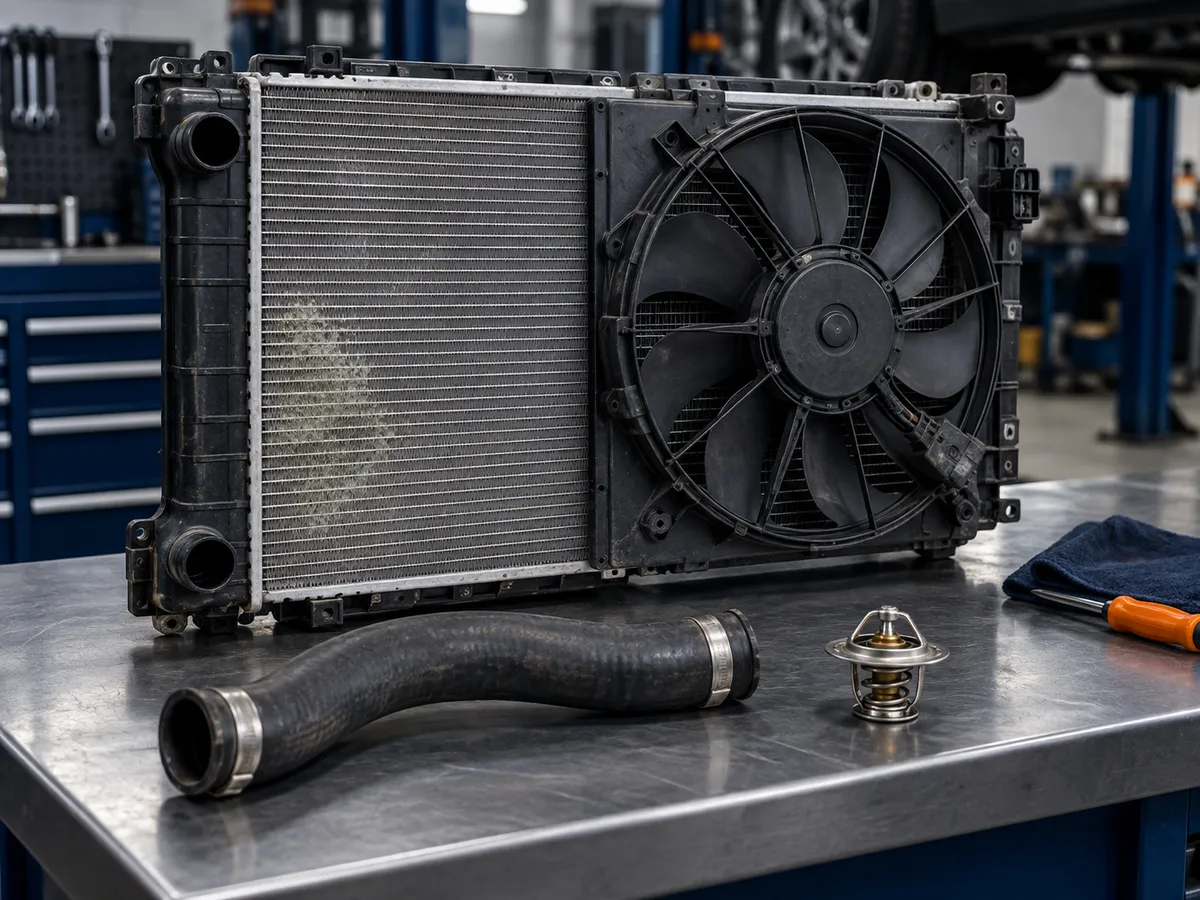
Mitsubishi Lancer overheating
An old radiator, fan or hoses can let the temperature climb in summer traffic. Below are the causes that fit a Mitsubishi Lancer, most likely first, and what fixes each one.
Why a Mitsubishi Lancer is overheating
1.3 L petrol · 1.6 L petrol
| Likely cause | How likely | The fix |
|---|---|---|
Water pump failureFits the Lancer A worn impeller or leaking seal stops coolant circulating. On engines where the timing belt drives the pump, it is normally changed with the belt. | Possible | Water pump replacement |
Lean running on CNGFits the Lancer A poorly tuned CNG kit runs the engine lean and hot, which stresses the cooling system and valves. Exhaust gas and temperature checks on gas versus petrol show it. | Possible | Cng kit inspection |
Low coolant from a leak Leaking hoses, radiator or water pump let coolant escape until the engine runs hot. A pressure test of the cooling system finds the leak. | Common | Coolant leak repair |
Radiator fan not working In city traffic there is little airflow, so the fan must do the work; a failed motor, relay or sensor lets the engine overheat at idle. Commanding the fan on with a scanner tests it. | Common | Cooling fan repair |
Thermostat stuck closed A stuck thermostat stops coolant reaching the radiator. A hot engine with a cool lower radiator hose points to it. | Common | Thermostat replacement |
Clogged radiator Plain water instead of coolant leaves scale inside, and dust blocks the outside fins. A temperature difference across the radiator confirms a blockage. | Common | Radiator cleaning |
Blown head gasket Combustion gases pushed into the coolant cause bubbles, pressure and overheating. A combustion leak (block) test confirms it. | Less common | Head gasket replacement |
Causes marked “Fits the Lancer” apply because of how this car is built: its petrol engine, MANUAL/AUTOMATIC gearbox, timing belt or a CNG conversion.
General guidance based on how these cars are built and how they commonly wear. Your car’s own history matters more than any list, which is why a technician confirms the cause before quoting.
Can you keep driving?
No. Pull over, switch off the AC, and turn the engine off. Do not open the radiator cap while hot; pressurised coolant can scald. Driving an overheating engine risks a blown head gasket.
Checks you can do first
- Once fully cool, check the coolant reservoir level against the marks.
- Look under the car and around the radiator for green, pink or blue fluid.
- With the engine warm and the AC on, check whether the radiator fan runs.
- Look at the front of the radiator for blocked fins from dust, leaves or insects.
How a technician diagnoses it on a Lancer
Step 1
Pressure-test the cooling system and cap.
Step 2
Check fan operation and coolant temperature sensor readings with a scanner.
Step 3
Measure inlet and outlet radiator temperatures with an infrared thermometer.
Step 4
Run a combustion gas test on the coolant if a head gasket is suspected.
Other Mitsubishi Lancer problems
- Lancer knocking from the suspensionWidely reported on this model
- Lancer leaking oilWidely reported on this model
- Lancer having trouble starting on CNGWidely reported on this model
- Lancer not starting
- Lancer cranking but not starting
- Lancer showing a check engine light
- Lancer vibrating through the steering wheel
- Lancer misfiring
- Lancer blowing blue smoke
Parts usually involved
Engine overheating on other cars
Get your Lancer looked at
Tell us the Mitsubishi Lancer, the symptom and where the car is. A person calls back to say what we can do in your city and what the diagnosis costs.
Before you book
Questions we get asked
If your question is not here, ask it. We would rather answer honestly now than have you find out after booking.